
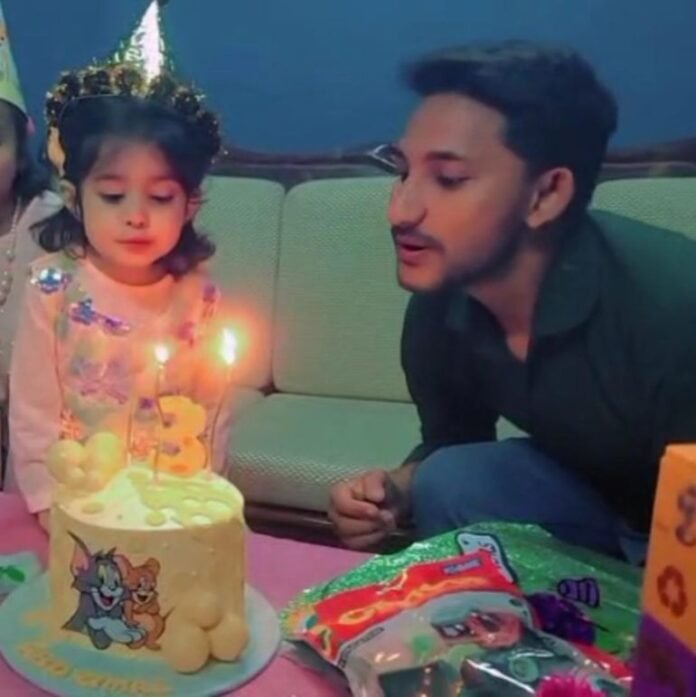
Islamabad, Pakistan – When Ayesha Ameen was leaving her house last week for a chore, her three-year-old daughter Zimal tugged at her sleeve and asked if she was finally going to the airport to pick up her father.
“How do you tell a three-year-old that her father is held captive and cannot come home?” Ayesha, 26, told Al Jazeera. “How can anybody answer that?”
Recommended Stories
list of 4 itemsend of list
Zimal’s father, Ameen bin Shams, 29, has been held hostage on board an oil tanker off the coast of Somalia for nearly two weeks. He is among 10 Pakistani sailors in the 17-member crew of the MT Honour 25, seized by Somali pirates on April 21. Besides the Pakistani nationals, the ship’s crew consists of four Indonesians – including the MT Honour’s captain – as well as one each from Sri Lanka, Myanmar and India.
Ameen’s daughter asks about him every day. His four-month-old son, Rahim, born on December 24, two weeks after Ameen left on his first merchant navy contract, has never met his father.
‘It was his dream’
Ameen had spent years working at a shipyard in Karachi before securing his first posting on board a merchant vessel. He joined the MT Honour 25 on December 9 through a Karachi-based crewing agency, serving as a fitter. The family lives in Malir Khokhrapar, a lower-middle-class neighbourhood of Pakistan’s biggest city.
The months before the hijacking were the happiest Ameen had been, Ayesha said. He would call at night, sometimes in the morning, often on video, showing her the sunrise over open water. He sent clips of dolphins, shared what he ate, where he sat, and what the ship looked like at different hours of the day.
“He often said: ‘This is a good life, I am quite enjoying this,’” she told Al Jazeera. “It was his dream to be part of the merchant navy.”
Ayesha’s sister’s wedding is on May 9. Ameen had been contributing from his earnings, more than he had ever made at the shipyard in Karachi. The family would go shopping and send him photographs of clothes and gifts. He would reply with excitement, even though he knew he would not be able to attend.
“He was glad the family was doing well,” Ayesha said.
One day in late April, Ameen mentioned he was filling out a next-of-kin form, a standard document for sailors in case something goes wrong at sea. Ayesha told him to stop, not to say such things, not to worry.
The next day, the ship was hijacked.
‘He was crying’
On April 23, two days after the capture of the vessel, a call came through. Ameen told Ayesha he was in a rush, panicked, as he disclosed the ship was hijacked. He said he loved his family. He asked her to give his love to Zimal and to Raheem, the son he had never seen.
“He was crying,” she said.
Families say pirates allowed brief, monitored calls in the days immediately after the capture. Several crew members managed to pass messages. Then contact thinned and, for some, stopped altogether.
Ayesha heard from him once more the following week. The call lasted three minutes. He asked her to contact civil society groups, charities, anyone who could push the government to act. In that last call, Ameen used the captain’s phone to speak to his father, said he was safe, and asked the family to pray for his return.
Also from Karachi, 23-year-old Muzammil Ahmed Ansari learned of his father’s captivity three days after the hijacking. Mehmood Ahmed Ansari, 55, has spent three decades at sea, working across ships, companies and oceans.
On this voyage, he was serving as third engineer, responsible for the engine room. He had joined from Dubai on January 17, with his contract due to end in July.
“He sent a voice note,” Muzammil told Al Jazeera. “He said, ‘We are hijacked, reach out to the company, to people, to the government.’ He said there were pirates on the ship, all armed. He panicked, but he said, ‘Don’t worry, ask the government to deal with it.’”
Nothing in those 30 years had prepared the family for this.
The days now blur into one another for them. “When we wake up in the morning, we wonder what news we will get,” Muzammil said. “When we sleep, we wonder what news will come the next day. It is like limbo. Not knowing what comes next.”
The MT Honour 25, a Palau-flagged product tanker carrying approximately 18,000 barrels of oil, was seized on April 21 about 30 nautical miles (equivalent to about 56km) off Somalia’s semi-autonomous Puntland region.
Six gunmen initially boarded the vessel; reinforcements later brought the number of pirates to at least 11. A Japanese Maritime Patrol aircraft from the Combined Maritime Forces confirmed the vessel’s location inside Somalia’s territorial waters, and EUNAVFOR Operation Atalanta deployed at least two warships to the region on April 25. Those ships remain in the vicinity of the MT Honour, according to the operation’s official statement.
The tanker is now anchored off the coast of Eyl in Puntland, Pakistan’s embassy in Djibouti said.
The vessel is operated by Wharf Chartering, registered in Indonesia, according to Pakistani media reports. Pakistan’s Ministry of Foreign Affairs said last week the ship is owned by a Puntland-based businessman.
Families say pirates have instructed crew members to appeal to their governments, insisting demands will be communicated directly to authorities. No ransom figure has been confirmed by Pakistani or Somali officials.
Al Jazeera contacted Pakistan’s Foreign Ministry and the Ministry of Information but received no response.
Conditions on board have deteriorated, according to families and the Ansar Burney Trust, a Karachi-based human rights organisation that says it has been in contact with the pirates.
Food and water supplies have run low. The ship’s fuel is reportedly near exhaustion. Some crew members have run out of essential medication. A video circulating on April 28 showed about a dozen people confined to a cramped cabin with no proper sleeping arrangements.
‘They are busy saving the world’
Pakistan’s Foreign Office spokesperson Tahir Andrabi said on April 30 that Islamabad was in contact with Somalia’s Ministry of Foreign Affairs, which had provided written assurances it was monitoring the situation and engaging with pirates and Puntland authorities. Pakistan’s embassy in Djibouti, accredited to Somalia, had confirmed the vessel’s location and the crew’s status.
Andrabi pointed to what he called a “silver lining” – the ship’s owner is from Puntland, and the vessel is anchored in familiar waters.
“Based on this discussion with the Somali Ministry of Foreign Affairs, we have fair reason to believe that our crew members are safe and secure, and the pirates and the owner of the ship are in contact,” he said.
At a news conference at the Karachi Press Club the same day, families of the hostages, some holding photographs of the missing men, children standing beside them, called for more direct government engagement. They asked for a high-level committee to be formed and for a focal person to provide regular updates.
For Ayesha, the response has felt hollow.
“What has been most frustrating is how callous, how heartless the government has been,” she told Al Jazeera. “Not a tweet. No video. No message. Absolutely nothing – not even verbal support. They are busy saving the world from a war, but they cannot reach out to their own citizens in this hour of need. We cannot expect help from outsiders. We are Pakistanis, who else do we look to if not our own government?”
She was referring to Pakistan’s ongoing mediation efforts between the United States and Iran, following the US-Israeli attacks that began on February 28. Pakistan helped broker the ceasefire initially, on April 8, and has subsequently been holding talks with both parties to bring them back to the table in order to sign a peace deal.
Muzammil was more restrained, but equally pointed. “Nothing from the ministry. Nothing from the federal government. Nothing from them on social media. We held a press conference; all the mainstream media was there but it did not get much coverage,” he said.
A resurgence taking shape
The Honour 25 is not an isolated case. At least three vessels have been seized off Somali waters since April 20, marking the most concentrated burst of piracy in years.
On April 26, the cargo ship Sward was seized six nautical miles (11km) northeast of the Somali town of Garacad. Its 15-member crew of Syrian and Indian nationals was taken captive. The United Kingdom Maritime Trade Operations (UKMTO) has raised its threat level for Somalia’s coast to “substantial”.
The conditions for a resurgence have been building. Anti-piracy patrols that had suppressed Somali hijackings for more than a decade were diverted to the Red Sea in 2023 to counter Houthi attacks on shipping in the Bab al-Mandeb Strait.
The US-Iran war and the closure of the Strait of Hormuz have stretched those deployments further. Brent crude prices have risen by more than 50 percent since the start of the war, now trading above $110 per barrel, making fuel tankers like the Honour 25 more valuable targets.
Honour 25 itself had been caught in these shifting currents. After loading oil and heading towards the United Arab Emirates, it attempted to transit the Strait of Hormuz before turning back. It was bound for Mogadishu when the pirates struck.
For Ameen’s wife, Ayesha, the past two weeks have turned into what seems like unceasing torture. “It felt like he was caught between a rock and a hard place,” she told Al Jazeera. “On one end was the war. On the other, there was what ended up happening.”