
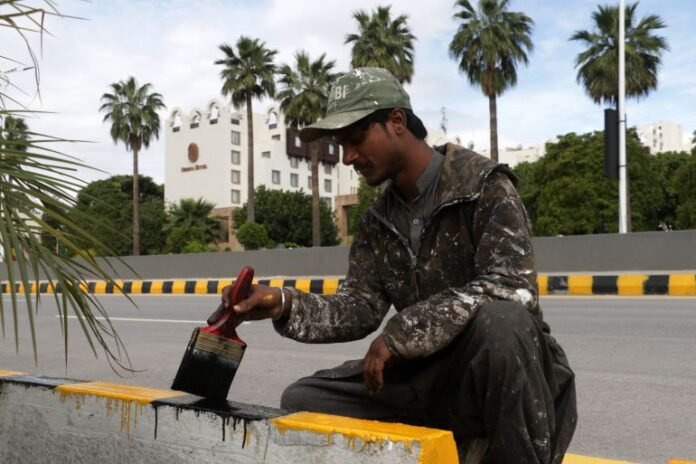
Islamabad, Pakistan – Pavements are being painted, an already formidable security presence is being bolstered, and an air of anticipation — and anxiety — is gripping Pakistan’s capital as it prepares to host meetings that the world will watch this weekend.
Exactly six weeks after the United States and Israel launched coordinated strikes on Iran that killed Supreme Leader Ayatollah Ali Khamenei, set off a war that has killed thousands of people across multiple countries, shut down the world’s most critical oil passage and sent energy prices soaring, Islamabad will on Saturday host talks involving top US and Iranian officials.
Recommended Stories
list of 4 itemsend of list
The meetings come days after both Washington and Tehran agreed to a Pakistan-mediated two-week ceasefire, and at a time when that truce is already under strain amid different interpretations of the terms of the pause in fighting — and Israel’s intensified bombing of Lebanon.
Iran’s attacks on its Gulf neighbours, apart from Israel, amid the war have also left the world’s biggest energy export hub and a critical nerve centre of trade, tourism and innovation on edge since the fighting started on February 28. Tehran’s decision soon after to in effect shut down the Strait of Hormuz — through which 20 percent of the world’s oil and gas passes during peacetime — except to ships from countries that negotiated deals with it, rattled global markets and drove energy prices to record highs.
This coming weekend, senior representatives from key players in the war will converge in Pakistan’s leafy capital in the lower reaches of the Margalla Hills.
Here is everything you need to know about the upcoming talks in Islamabad — from who is expected to attend and where they will be held, to what’s on the agenda, potential roadblocks and what the world can expect.
When and where will the talks be held?
The negotiations are set to begin this weekend in Islamabad after Pakistani Prime Minister Shehbaz Sharif formally invited both sides to pursue talks towards a full settlement of the war.
The White House has confirmed that formal discussions will start on Saturday morning local time.
Iran’s Supreme National Security Council said on April 8 that talks could continue for up to 15 days — suggesting the possibility that at least some members of the delegations may stay in Islamabad beyond Saturday, or return to the Pakistani capital for subsequent rounds of talks.
Islamabad’s Serena Hotel will host the delegations. Located next to the foreign ministry in the capital’s Red Zone, which houses key government buildings and embassies, the hotel has been requisitioned from Wednesday evening through Sunday, with guests asked to vacate.
It is also expected to serve as the venue for the talks.
Authorities have declared April 9 and April 10 public holidays in the federal capital, exempting essential services such as police, hospitals and utilities.
Security has been tightened across the city. The Red Zone has been sealed, while key entry points into Islamabad have also been closed.
Who will attend the talks?
The White House has confirmed that US Vice President JD Vance will lead the American delegation, joined by President Donald Trump’s top envoy Steve Witkoff and son-in-law Jared Kushner.
Iranian Parliament Speaker Mohammad Bagher Ghalibaf and Foreign Minister Abbas Araghchi are expected to lead the Iranian delegation. It is unclear whether any representative from Iran’s Islamic Revolutionary Guard Corps (IRGC) — which is leading Tehran’s military response in the war — will attend the talks. Ghalibaf is a former IRGC commander.
But Pakistani officials cautioned that nothing was a certainty until the delegations actually arrived.
Iran’s ambassador to Pakistan, Reza Amiri Moghadam, briefly announced on X that the Iranian delegation would arrive on April 9. “Despite skepticism of Iranian public opinion due to repeated ceasefire violations by the Israeli regime to sabotage the diplomatic initiative,” he wrote, the delegation had come for “serious talks based on the 10 points proposed by Iran.”
But he deleted the post within hours.
What will the negotiations look like?
Prime Minister Sharif is expected to formally host the talks and hold separate preliminary meetings with both sides on Friday or early Saturday morning, depending on when the teams arrive.
Deputy Prime Minister and Foreign Minister Ishaq Dar, who has been involved in shuttle diplomacy throughout the conflict, is expected to facilitate the actual negotiations on Saturday.
It remains unclear whether Pakistan’s army chief, Field Marshal Asim Munir, will take part. Neither the foreign ministry nor the military’s media wing responded to Al Jazeera’s queries.
On Saturday, the US and Iranian teams are expected to sit in separate rooms, with Pakistani officials carrying messages between them.
Vance’s inclusion in the talks is a key development. Iranian officials are sceptical about further engagement with Witkoff and Kushner — they point to earlier negotiations with them in Muscat and Geneva in February, and how the US started bombing Iran even as talks were ongoing. They view Vance as more open to ending the conflict.
Seen as a potential contender for the 2028 Republican presidential nomination, Vance has positioned himself as cautious about prolonged US military involvement in the Middle East.
More than three dozen visa applications from international media outlets have been submitted, with at least 20 journalists approved, according to officials, who also confirmed that a 30-member US security team has already arrived in Islamabad.
Why Pakistan?
Pakistan has emerged as a key intermediary between Washington and Tehran in recent weeks. Despite past tensions with both countries, Islamabad currently maintains working ties with each.
In recent days, army chief Asim Munir has held multiple calls with US and Iranian leaders during intense diplomatic efforts.
Pakistan shares a 900km (560-mile) border with Iran and hosts the world’s second-largest Shia Muslim population after its neighbour, factors that enhance its relevance to Tehran.
Unlike much of the Middle East, Pakistan does not host US military bases, giving it additional credibility in Iranian eyes. At the same time, Pakistan has been designated a Major Non-NATO Ally of the United States since 2004.
Yet the US ambassadorial post in Islamabad has often remained vacant. Since 2018, only one confirmed ambassador, Donald Blome, served from 2022 to early 2025. The position is currently unfilled.
The last sitting US president to visit Pakistan was George W Bush in March 2006.
The last vice president to visit Pakistan was Joe Biden in January 2011.
Vance’s expected visit — 15 years later — centred on negotiating an end to a war rather than bilateral ties, marks a rare and significant level of US engagement in Islamabad. It is rare for a vice president to visit a country where the US doesn’t have an ambassador.
What is on the table?
Both sides enter the talks with major differences.
Iran’s 10-point proposal for peace calls for Iranian oversight of the Strait of Hormuz, the withdrawal of US combat forces from the Middle East, and a halt to military operations against allied armed groups, among other demands.
The United States has not formally accepted these terms, though Trump has called the 10-point plan “workable”. The White House has instead claimed Iran is willing to surrender its stock of enriched uranium, a position spokesperson Karoline Leavitt described as a non-negotiable demand. Iran has not — officially, at least — accepted that it is ready to give up its enriched uranium.
A separate dispute centres on Lebanon.
Israel’s bombing of its northern neighbour, in which more than 200 people were killed on Wednesday, was its most intense attack on Lebanon since the start of the current war.
Araghchi warned that Tehran could abandon the ceasefire if Israeli strikes continue, saying the US must choose between a ceasefire or continued war via Israel. He cited Pakistani PM Sharif’s assertion that the ceasefire included a pause in attacks across the region, including Lebanon.
Vance, speaking in Budapest, however, said the ceasefire terms did not cover Lebanon — a position that Trump and the White House have taken.
Masood Khalid, a former Pakistani ambassador to China, told Al Jazeera the atmosphere had been poisoned before talks even began.
“Israel is playing a spoiler to undermine the process,” he said. “Its relentless bombing of Lebanon is meant to trigger a scenario whereby parties further harden their positions and the process is scuttled. At this stage, we can only be cautiously optimistic as talks would surely be complicated and cumbersome and may need to be extended beyond a 15-day deadline.”
Sahar Khan, a Washington, DC-based independent analyst and nonresident fellow at the Institute for Global Affairs, agreed.
“Lack of trust is the biggest obstacle,” she told Al Jazeera. “Right now, both Washington and Tehran are trying to demonstrate that they ‘won’ by making maximalist demands, but if this ceasefire holds and they actually meet, that will be the most important step.”
What are the possible outcomes and potential obstacles?
A final settlement remains unlikely in the short term, with deep mistrust on both sides, say analysts.
Iran’s ambassador to Islamabad, Amiri Moghadam, signalled in his now-deleted post that Tehran views continued Israeli strikes as an attempt to derail negotiations.
Lebanon is emerging as the central faultline. Khalid said that Sharif’s invitation had explicitly referenced Lebanon, suggesting prior discussions with Washington.
“Netanyahu [the Israeli prime minister] immediately rejected Pakistan’s stance while President Trump also subsequently excluded Lebanon from the scope of the ceasefire,” the former ambassador said.
“Iran, on the other hand, is insistent on stopping Israeli aggression in Lebanon, and it has the support of some key countries like France. The key is in President Trump’s hands,” the former envoy added.
Khan described Lebanon as the potential “breaking point” between the US and Israel.
“A sustainable settlement is only achievable if Israel stops attacking. In all the rounds of negotiations, it’s Israel that has broken them by attacking Iran. Ultimately, it’s up to the US: abandon the ceasefire and attack Iran or tell Israel to abide by the ceasefire or else,” she said.
Dania Thafer, executive director of the Gulf International Forum, said Israel’s absence from the talks was a structural challenge.
“Israel being a party to the war, and the one who has the most interests vested in continuing this war, needs to be part of the negotiation and the final settlement,” she said. “Otherwise, they could always argue that Israelis did not agree to the terms of any agreement.”
Khalid suggested that maximalist positions may eventually soften.
“A modicum of agreement between the US and Iran on the nuclear issue and a kind of multilateral understanding to open the Strait of Hormuz may be possible, as both sides are showing signs of fatigue and want a reprieve from hostilities,” he said.
On the question of a guarantor of peace, he was sceptical.
“No single country would be willing to be a guarantor on US or Israel’s behalf,” he said. “China cannot take the risk of guaranteeing American and Israeli behaviour.”
Any agreement, he added, would likely require backing from key Middle Eastern states, the permanent members of the United Nations Security Council and a binding resolution.
Washington-based Khan suggested the guarantor question was premature, as “China doesn’t need to be there for this round.
“Ceasefires are iterative and the first goal is to build trust. If the US can tame Israel and get it to stop attacking Lebanon during these talks, that’ll be significant, and Trump could chalk that up as a win,” she said.