
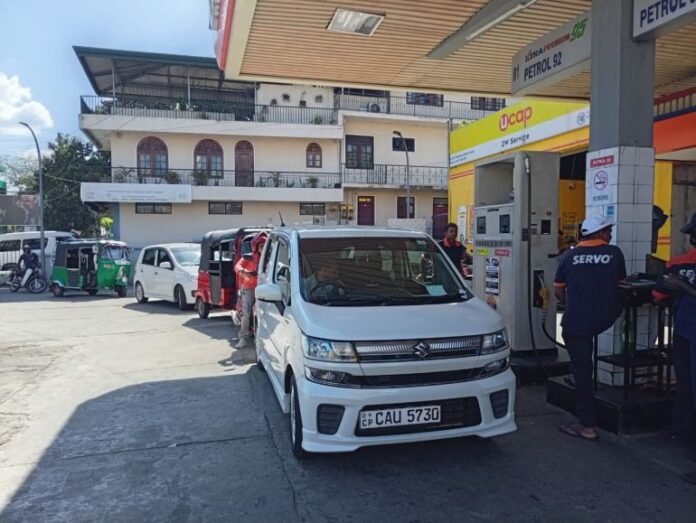
Kandy, Sri Lanka – On a sunny March day in the hill city of Kandy in central Sri Lanka, Keerthi Rathna waited in a serpentine queue to buy his share of petrol for his three-wheeler tuk-tuk.
The government-allocated ration for him was 20 litres (about 5 gallons) per week. In the past, Rathna used to buy as much petrol as he needed, whenever he needed it, but everything has changed since the United States and Israel launched their war on Iran on February 28.
Iran responded by halting most traffic via the Strait of Hormuz, through which 20 percent of the world’s oil and gas passes.
Sri Lanka imports 60 percent of its energy needs, much of it through the strait. It also has no storage capacity beyond one month’s consumption needs. With the passageway largely closed, the South Asian island nation of 22 million introduced a QR-based fuel ration arrangement, a system followed by the government during the economic crisis of Sri Lanka in 2022.
Based on this per-week ration system, motorbikes are allowed eight litres of petrol, tuk-tuks 20 litres of petrol, cars 25 litres of petrol, buses 100 litres of diesel, and lorries with 200 litres of diesel.
But even that limited fuel now comes at a higher cost: Sri Lanka has raised the price of fuel by approximately 33 percent since the start of the war on Iran. With fertilisers too now impacted dramatically – almost half of the world’s urea comes via the Strait of Hormuz, experts expect food prices in Asia to also rise significantly. Researchers at the Kiel Institute for the World Economy (PDF) estimate that Sri Lanka could see a 15 percent overall increase in food prices.
For many Sri Lankans, their deepening woes carry echoes of a crisis they thought they had put behind them.
‘A familiar system, but a shock’
Sri Lankans suffered this ration system and price hike four years ago, during the economic crisis under the presidency of Gotabaya Rajapaksa.
The government led by Rajapaksa was accused of driving the Sri Lankan economy into a state of collapse by adopting policies that led the country to default on its foreign debts, for the first time in its history.
A foreign exchange shortage eventually forced Sri Lanka to restrict the import of goods – including fuel – resulting in soaring prices of essentials.
Rajapaksa fled the country after a youth-led popular uprising against him in July 2022.
Rathna, who is in his mid-60s, said there was a difference between the economic struggles then and those facing Sri Lanka now. Sri Lanka elected a left-leaning government in 2024, two years after Rajapaksa’s ouster.
“This time, no one can put the blame on this government as the war on Iran is not in Sri Lanka’s hands,” Rathna told Al Jazeera.
Still, the current government, under President Anura Dissanayake, faces major challenges as the war in the Middle East continues.
‘Loss despite price hike’
Nalinda Jayatissa, a Sri Lankan minister and cabinet spokesperson, has publicly said that while bus fares – which impact low-income Sri Lankans disproportionately – were increased by more than 12 percent because of fuel price hikes, they would be lowered if fuel costs drop.
But that’s little reassurance for many Sri Lankans at the moment: Their incomes haven’t gone up, only the cost of living has.
Shiran Illanperuma, a political economist at the Tricontinental: Institute for Social Research think tank, told Al Jazeera that “the knock-on effect of the fuel crisis will be drastic for Sri Lanka”.
Despite the fuel price hike, the Sri Lankan government is bleeding $63m in monthly losses, Jayatissa has said.
An official from the Sri Lankan Ministry of Energy, who spoke with Al Jazeera on condition of anonymity as he was not authorised to speak to the media, explained this loss – and its economic rationale.
“What we have increased [in terms of the price at petrol pumps] is less than the hike in the international market,” the official said, explaining that the Sri Lankan government was effectively subsidising fuel for its citizens by absorbing the remainder of the increased cost of fuel that the country imports.
That’s not just a social welfare measure, the official explained. The loss resulting from this subsidy, he argued, would be less than the hurt to the economy if the full price hike were reflected at petrol stations: Transport would be crippled, work would come to a standstill and jobs would be lost. “It could lead to insufficiency and unproductivity in industries,” he cautioned.
“The future of this crisis cannot be predicted, but the government is fully prepared to support the people,” he asserted.
Alongside fuel rationing, Sri Lanka has adopted a no-work-on-Wednesday policy, closing government offices and schools that day in order to minimise fuel consumption.
‘Alternative sources’
After the US relaxed some sanctions on Russian fuel, the Sri Lankan government is also negotiating with Moscow to buy fuel. Russia’s Deputy Energy Minister Roman Marshavin visited Sri Lanka this week for talks.
Tricontinental’s Illanperuma said that Sri Lanka could enter into a bilateral agreement to buy Russian fuel at a concessionary price, as neighbouring “Indian oil refineries are well equipped to refine Russian fuel”.
On the other hand, Sri Lanka has thanked Iran for extending an offer to supply Iranian fuel, but the offer was turned down because “Sri Lanka has no ship to transport the fuel”, Jayatissa, the cabinet spokesperson, told reporters.
Sri Lanka’s state-owned Litro Gas, which has the largest share in the liquefied petroleum gas (LPG) market in Sri Lanka, has storage facilities for only 8,000 metric tonnes of LPG, while the national consumption is approximately 33,000 metric tonnes a month.
Jayatissa told reporters that orders are placed and stocks are expected to arrive in the Maldives, from where they will be transported via small vessels to Sri Lanka.
Mohamed Sahir, an LPG vendor, told Al Jazeera that the shortage of LPG was partly created by panic buying. “The market has LPG cylinders, although there is a gap between demand and supply. I used to get 50 cylinders, but now I get only 35 cylinders, “ he told Al Jazeera.
LPG prices have risen by about 8 percent in Sri Lanka, after the start of the war on Iran.
‘We will be in trouble’
Political economist Illanperuma said that in the short term, there is not much the government can do other than fuel rationing, limiting fuel consumption and declaring holidays.
In the medium term, he suggested that Sri Lanka should focus on building storage capacities.
“Sri Lanka has no sufficient storage facilities to stock fuel for longtime consumption, unlike other countries which have sufficient storage facilities for months,” Illanperuma said.
Sri Lanka stores its fuel reserves – mainly in three storage facilities across the country – but can hold reserves only enough for one month’s consumption.
Soon after the start of the war on Iran, President Dissanayake told lawmakers that Sri Lanka was building eight more facilities – they would be able to collectively hold another week’s worth of fuel.
On the other hand, Sri Lanka has entered into an agreement with India and the United Arab Emirates to renovate and use a colonial-era fuel storage farm in the eastern town of Trincomalee.
But fuel aside, Illanperuma pointed out that if the traffic halt in the Strait of Hormuz continues, it will impact Sri Lanka’s food security.
“We import fertilisers from China, and its main ingredient, sulphur, comes from the Middle East. If China fails to source sulphur, we will be in trouble.” Illanperuma told Al Jazeera.
For Rathna, the tuk-tuk driver, the current moment also carries a strange irony.
“During the 2022 economic crisis, the fuel ships were anchored around the country. But the government had no money to buy it,” he recalled.
Now, he said, the government has foreign currency reserves, “but the ships are not arriving”.