
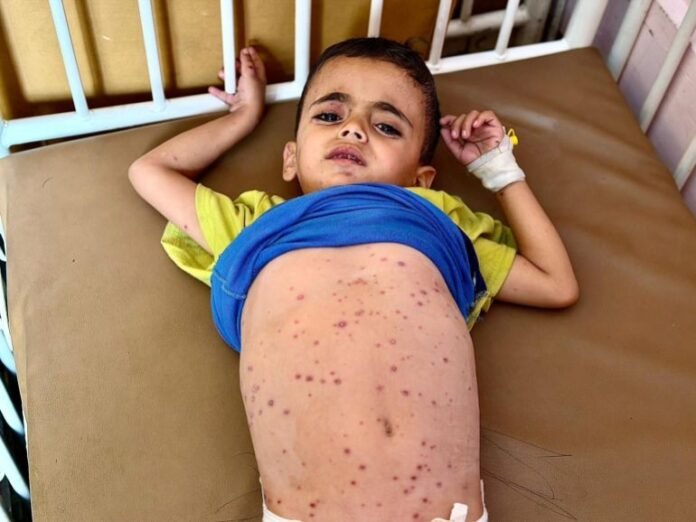
Khan Younis, Gaza Strip – In a corridor inside Nasser Hospital, Iman Abu Jame sits beside her six-year-old son, Yasser, as she watches his frail body, exhausted by illness, and tries to make sense of what has happened to him.
Yasser’s skin is covered in angry rashes and burn-like wounds that doctors cannot explain. His body is frail from hunger.
Recommended Stories
list of 3 itemsend of list
For the 32-year-old Iman, Yasser’s illness cannot be separated from the suffering caused by more than two and a half years of Israel’s genocidal war on Gaza.
Their family lives in a cramped tent in al-Mawasi, west of Khan Younis, an area full of fellow displaced people, which Iman describes as catastrophic.
The heat is suffocating. Garbage piles up around the tents. Contaminated water is all many families can access. Insects and rodents crawl through overcrowded shelters where thousands of displaced people are packed together with no sanitation and little food.
Israel places severe restrictions on the entry of humanitarian aid into Gaza despite an October ceasefire that was supposed to see the amount of aid entering the Palestinian enclave ramp up.
Before the war, Yasser was healthy, Iman says. Then came the hunger.
Months of severe food shortages and soaring prices left the family unable to afford even basic meals. Malnutrition weakened his body first. Then came the infections.
“I have never seen infections like these in my life,” Iman tells Al Jazeera. “But there are children all around us in this hospital suffering from the same kinds of rashes.”
Doctors have so far failed to clearly diagnose Yasser’s condition. New marks continue appearing across his body while his strength withers.
“Malnutrition was the beginning,” his mother says. “… His father does not work, and we cannot provide food, milk or vegetables. We cannot even afford medicine, which is why I brought him to the hospital.”
“He would ask for food like any child, but we had nothing to give him,” she adds.
Children most at risk
As the family continues to struggle inside the camp, infections spread rapidly through the overcrowded tents, where disease moves easily among children already weakened by hunger.
Yasser’s story is becoming increasingly common across Gaza.
Medical teams from Medical Aid for Palestinians (MAP) say skin diseases are spreading at alarming rates among displaced families forced to live in overcrowded camps.
According to Gaza’s Ministry of Health, more than 17,000 ectoparasitic infections – caused by parasites living on or under a human’s skin – were recorded in 2026 alone.
In April, MAP screened 7,017 people across six primary healthcare centres in Gaza. Of the 1,325 people diagnosed with skin diseases, more than 62 percent were children.
Among them were 168 children under the age of two, 259 aged three to five, and 245 six to 12 years old.
At MAP’s Solidarity Polyclinic in Deir el-Balah in central Gaza, scabies made up nearly a third of all infectious disease cases recorded in April. The clinic has treated more than 77,000 people in its first year as Gaza’s healthcare system continues to collapse under the strain of war, displacement and a lack of supplies and equipment.
Dr Rana Abu Jalal, who works at the clinic, says doctors are witnessing a “sharp rise” in skin diseases, particularly scabies, with many cases progressing into severe infections and painful abscesses.
“What affects me most is the impact on children,” she said. “They are the most vulnerable.”
She said the spread of disease is being driven by overcrowded tents, unsafe water, poor ventilation and the near-total absence of hygiene supplies.
“Families tell us every day how they are trying to cope,” she said. “But these conditions are simply beyond their control.”
Disease spreads
In Khan Younis, Dr Alaa Ouda, who works in a MAP-supported clinic serving six camps for displaced people, says he now treats 70 to 80 patients every day suffering from scabies, flea infestations, infected insect bites and fungal infections.
“The fleas we are seeing are carrying scabies,” he said. “And there is another type of insect we still have not identified. Its bites resemble spider bites and often develop into infections and open sores.”
He added that fungal scalp infections among girls are spreading rapidly through the camps.
“Once a single case appears, it spreads quickly because of overcrowding, poor hygiene and insects everywhere,” he said.
But even as cases surge, medicines have almost disappeared.
“The issue is no longer scarcity,” the doctor said. “It is near-total absence.”
Permethrin, one of the main treatments for scabies, is no longer available, he added.
Mohammed Fathi, a community health worker with MAP, says many families have stopped seeking treatment altogether because medicines are unavailable and children are sent back into the same dangerous conditions that made them sick in the first place.
“People have lost hope,” he said. “Even if treatment is available temporarily, the root cause remains unchanged.”